


Throughout the SUNY system, higher education in prison (HEP) programs work closely with the New York Department of Corrections and Community Supervision (DOCCS) to support effective program delivery. The SUNY Office of Higher Education in Prison uses system-level data to monitor student progress, identify opportunities for improvement, and inform innovations in faculty and student support. Central to this work is OHEP’s longitudinal data system (LDS), which integrates data from multiple sources to provide a clear picture of students’ educational pathways, progress and outcomes over time.
The multi-year, longitudinal analysis of HEP students’ progress and outcomes aligns with the rigorous outcomes tracking applied to all SUNY students, while modifications to the analysis are made to account for distinct barriers faced by incarcerated and formerly incarcerated students, particularly related to reentry and post-release employment.
We’ve been measuring educational outcomes, such as persistence, retention, and completion for students enrolled in HEP programs since 2016. But most recently, we’ve extended this work to examine labor market outcomes after release, aiming to answer a more difficult question: not just if students are completing degrees, but whether degree completion is translating into meaningful economic opportunity. Measuring that outcome is far less straightforward than it may appear.
It is already well-documented that higher educational attainment leads to higher earnings among the wider population. According to the US Census Bureau, median annual earnings for those aged 25+ in New York with a high school diploma are approximately $35,000, compared with $43,000 for those with even some college or an associate degree (in 2021 dollars). The data presented in this 2015 report on mean and median occupational wage in New York State from the Department of Labor confirms this trend. Those with a high school diploma show a mean wage of $34,500, compared with $45,600 for those with some college, but no degree, and $59,900 for those with an associate degree.
The work discussed here builds on efforts to track graduate wages from SUNY’s Office of Institutional Research and Data Analytics, which develops and maintains SUNY’s gradwages dashboard. SUNY gradwages allows prospective and current students to explore historical labor market outcomes by program of study, informing their own choices about what programs to pursue. This post highlights key findings to date on labor market outcomes for participants in SUNY HEP programs, discusses methodological challenges encountered, and outlines next steps for advancing this analysis. Early results suggest that interpreting employment outcomes for SUNY HEP students, especially using standard metrics like mean and median wages, is more complicated than expected.
Data source & initial analysis
The data for this analysis is from New York State Department of Labor’s (DOL) unemployment insurance system,which includes quarterly wages reported by employers covered by New York State’s Unemployment Insurance (UI) Law. According to DOL, 97% of New York’s nonfarm employment is covered by the UI Law and therefore included in this dataset. Notable exclusions are self-employed people, federal employees, student workers, or private household workers. The data source does not clarify whether employment is full- or part-time, so we use a minimum annual earnings threshold as a proxy for sustained employment.
In compliance with DOL’s data sharing restrictions, wages are only reported for cohorts with at least 11 students distributed among more than three employers. By rule, a single employer cannot employ more than 80% of the students in a cohort. Due to those data limitations, we cannot yet analyze wages earned by students in a specific SUNY campus HEP program. In the latest UI wage data, there are often fewer than 50-100 HEP students appearing each year.
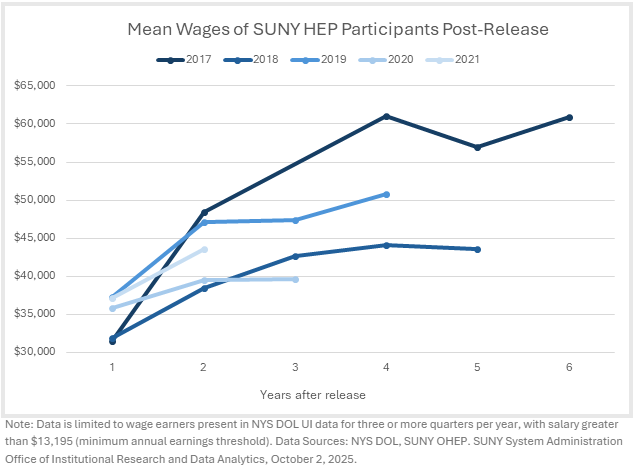
The chart below shows trends in the overall population of released HEP participants (inclusive of anyone engaged in SUNY HEP courses while incarcerated in state correctional facilities) dating back to 2015. Results indicate that wages are low in the initial years after release but steadily increase as expected thereafter. Variation across cohorts presented in the chart below is not noise to be filtered out or smoothed over. It reflects instability in outcomes at these small sample sizes.
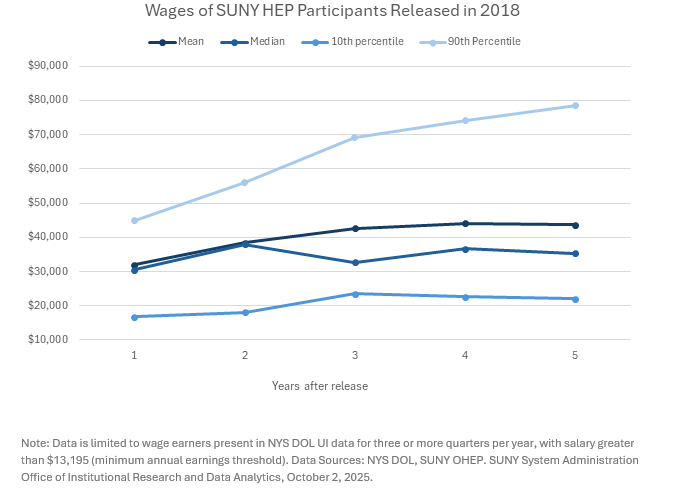
With small cohort sizes, the conclusions drawn from wage data vary substantially depending on the wage statistic used. While averages would traditionally be sufficient to tell a story about students’ experience, with small cohort sizes, these summary statistics can be actively misleading. For students released in 2018, wages at the 90th percentile increase steadily over time, while those at the 10th percentile show little movement. These additional statistics help to paint a more nuanced picture than the mean or median wage shows; HEP participants can have vastly different wage outcomes over time based on their early post-release earnings.
As we expand HEP programming system-wide and expect larger cohorts with additional years of data for each cohort, we will be able to draw more definitive conclusions about wage trajectories for SUNY HEP students.
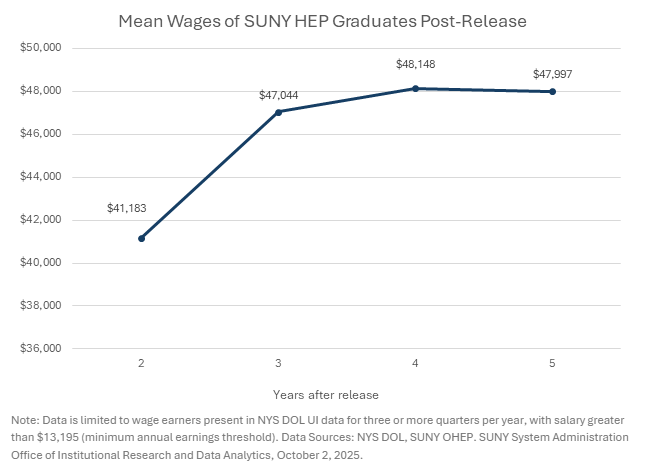
For graduates from SUNY HEP associate degree programs between 2018 and 2021, mean wages increase most dramatically before year three post-release, leveling off in subsequent years. While this is a useful initial finding to clarify early wage trajectories for SUNY HEP grads, it’s important to note that sample sizes for this analysis are small (n < 50), and comparing to wage trajectories of non-graduates is a necessary next step.
Addressing limitations
The constraints of this data and reporting shape what can be rigorously observed about students’ employment outcomes. UI wage data excludes self-employment and informal work, both of which are common during early reentry. Meanwhile, data suppression rules for small cohorts limit the level of detail that is reportable. As a result, UI wage data analysis for HEP students likely understates early employment activity and variation across programs.
Another consideration is the appropriate time horizon for analyzing wages of HEP grads, knowing it takes additional time for them to break into traditional W-2 employment post-release. For non-HEP students, wages are typically checked three years after graduation. But for our population of students, this timeline may not be sufficient. It’s worth exploring the value in some standardized, reentry-adjusted timeline for future wage analyses for HEP students.
We aim to increase the number of HEP programs and students, which will help overcome sample size limitations discussed throughout this post. With more data, more students and more time, we’ll have more confidence in the story told by data discussed here.
Merging longitudinal data systems from universities across the country into a national HEP data system is another potential solution to overcome analytical constraints resulting from small sample sizes, but this approach may bring about other challenges. On its own, this quantitative data misses the important context on regional differences in New York, particularly when comparing urban versus rural areas – SUNY HEP alumni returning to NYC after release have vastly different experiences than those returning to the North Country, for example. Our statewide LDS is valuable because it’s paired with lived experience and qualitative expertise of the OHEP team, operating throughout these different communities across New York. SUNY OHEP’s current research prioritizes “thick data,” maintaining context and nuance to ensure our quantitative research findings don’t oversimplify, or “average out” the SUNY student experience, leading to misinformed support systems for these students.
Next steps
Taken together, this analysis suggests that standard approaches to measuring postsecondary outcomes do not fully translate to HEP populations. Interpreting wage data in this context requires both methodological caution and a broader understanding of reentry pathways.
At SUNY OHEP we will continue exploring how to leverage DOL data to serve our students and to paint a clearer picture on their employment outlook after release as it relates to their chosen field of study. We will think creatively about how to package wage data analyses, such as reviewing how best to aggregate cohorts for data presentation. Where UI wage data is incomplete, we will look for alternative data sources to supplement the analysis. We will continue to share updates and preliminary results as we work towards a replicable methodology for wage trends analysis for other HEP providers aiming to offer their students transparency in this way.
Contributing writer – Brendan Mapes, Data Analytics Development Manager, SUNY Office of Higher Education in Prison; Cara Wohnsigl, Research and Data Associate, SUNY Office of Higher Education in Prison; Rachel Sander, Executive Director, SUNY Office of Higher Education in Prison