
If you want a career in healthcare and don’t want to be a nurse, join the club.
Are you looking for a major in healthcare but the conversation always seems to start and end with nursing? While nursing is an impactful and fulfilling career, it’s not the only path into healthcare. The healthcare industry is vast and constantly evolving, meaning there’s plenty of options to explore that will match your strengths, interests, and goals.
According to rankings by U.S. News & World Report, more than half of the 100 Best Jobs for 2026 are in health sciences and wellness, and many of the pathways to those careers can be found at SUNY. SUNY offers over 400 health and wellness programs, ranging from advanced professional degrees to allied health options. These include programs that require graduate study as well as certificates, associate degrees, and bachelor’s degrees.
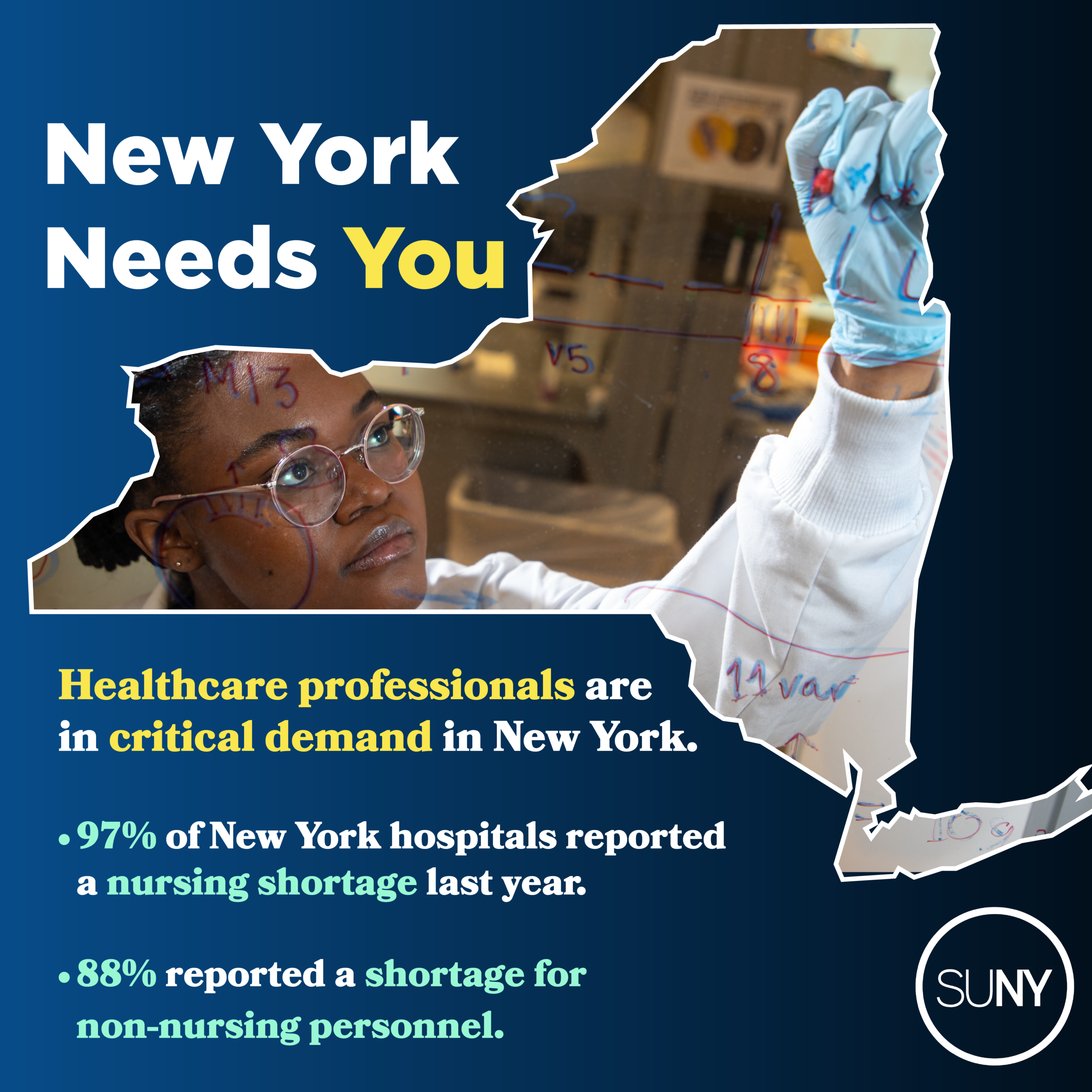 In New York alone, 97% of New York hospitals reported a nursing shortage, and 88% reported a shortage for non-nursing personnel.
No matter your interests, healthcare careers offer meaningful work, strong job demand, competitive salaries, and clear opportunities for growth and advancement. And with SUNY’s wide range of programs, you can find a path that fits your goals – whether you’re just beginning your education or planning your next step.
To help get you find the best healthcare career, here is a list of 20 healthcare majors offered at SUNY
1. Addiction Counseling: Prepares students to provide support for individuals struggling with substance abuse by studying the psychological and biochemical impacts of addiction. Graduates often pursue careers in rehabilitation centers, hospitals, treatment facilities, etc.
2. Administrative Business Technology – Medical: Focuses on medical terminology, medical transcription, medical coding, medical billing, and medical office procedures. Graduates often pursue careers in healthcare offices, hospitals, research institutions, insurance companies, pharmaceutical companies, etc.
3. Communication Disorders: Centered on challenges that can impact speech, language, and hearing. Graduates often pursue careers in speech-language pathology, audiology, and related areas like deaf education.
4. Dental Hygiene: Prepares students to promote oral health and receive licensure through the study of dental anatomy, patient care, clinical techniques, and radiology. Graduates often pursue careers in dental clinics or private practices.
5. Dietetic Studies: Focuses on nutrition, food preparation, and how diet can prevent and manage diseases. Students explore the human metabolism, community nutrition, and food management. Graduates often pursue careers as dietitians in hospitals, nursing homes, wellness programs, etc.
6. Emergency Services: Prepares students to be certified as Emergency Medical Technicians (EMT) by focusing on how to respond to medical emergencies, safety procedures, crisis management, and pre-hospital care. Graduates often pursue careers in emergency medical services, fire departments, disaster response, etc.
7. Exercise Science: Focuses on understanding the human body through kinesiology, cardiopulmonary assessments, and exercise physiology. Graduates often pursue careers in fitness training, physical therapy, rehabilitation, etc.
8. Health Care Management/Administration: Focuses on the business and administrative aspect of healthcare touching on technology, finance and economics, human resources, etc. Graduates often pursue careers overseeing health services and managing hospitals or clinics.
9. Health Information Technology: Centered on advancing the implementation and effective management of electronic health records by covering healthcare documentation, medical transcription, medical insurance, automated medical office communications, etc. Graduates often pursue careers in medical offices and health information departments.
10. Health Science: Focuses on a wide range of health-related courses from biology to human development and critical care. Programs in health science are a great place to start as a pathway into medical school, medical research, PA programs, and SUNY’s professional schools.
11. Massage Therapy: Provides insight into methods surrounding rehabilitation treatment, athletic training support, and spa services through classes on anatomy, physiology, kinesiology, psychology, etc.
12. Medical Assistant: Prepares students to support physicians and nurses by taking vitals, preparing patients for examinations, collecting and preparing lab specimens, scheduling appointments, billing, and filling out insurance. Graduates often pursue careers in physicians’ offices, clinics, ambulatory care facilities, emergency centers etc.
13. Medical Imaging Sciences: This specialty program offered at SUNY’s Upstate Medical University prepares students to practice radiography (X-ray), CT or MRI. Students must take prerequisite courses before transferring to these programs. Graduates often pursue careers in hospitals, clinics, doctor’s offices, and imaging centers.
14. Medical Laboratory Science: Prepares students for careers in laboratory testing, clinical diagnostics, forensics, and more. Students often build a foundation in coursework focused on biology and chemistry before moving into more focused studies and clinical work.
15. Radiologic Technology: Also known as X-ray technology, prepares students to capture photographic and digital anatomical images for diagnostic or research purposes. SUNY offers two-year programs in radiologic technology, advanced courses of study, and license exam readiness.
16. Respiratory Care: Prepares students to provide care for patients with deficiencies and abnormalities of the cardiopulmonary system such as asthma or cystic fibrosis. Graduates often pursue careers in hospitals, rehabilitation centers, nursing homes, pulmonary function labs, and physicians’ offices.
17. Physical Therapy: Prepares students to support patient recovery from injuries and manage chronic conditions through exercise, movement, and education. At SUNY, students can enroll in two-year programs that prepare them to become a physical therapist assistant or pursue a Doctorate of Physical Therapy (DPT). Multiple four-year schools offer combined programs with Upstate Medical University to earn this degree in six years.
18. Pre-Optometry (3+4 with Optometry): Prepares students for a fulfilling career in eye and vision care. SUNY’s College of Optometry offers a combined seven-year track in partnership with multiple four-year SUNYs across New York. Students enroll in this program with a participating four-year campus, then transfer seamlessly to the College of Optometry to complete a professional degree.
19. Public Health: Focuses on the study of healthy behaviors, life expectancy, population health, diseases, and community impact. Students learn about the environmental factors affecting community health and ways to make improvements through policy and investment. Graduates often pursue careers in policy advocacy, nutrition, health education, and environmental science.
20. Surgical Technology: Teaches students to prepare operating rooms, arrange equipment, cleaning instruments, and assist doctors during surgical procedures. Graduates often pursue careers as members of a surgical team in hospital operating rooms, physician offices, or labor and delivery suites.
Looking for more pathways into healthcare? SUNY offers 400+ programs. Visit Health and Wellness – SUNY to find the right major for you.