
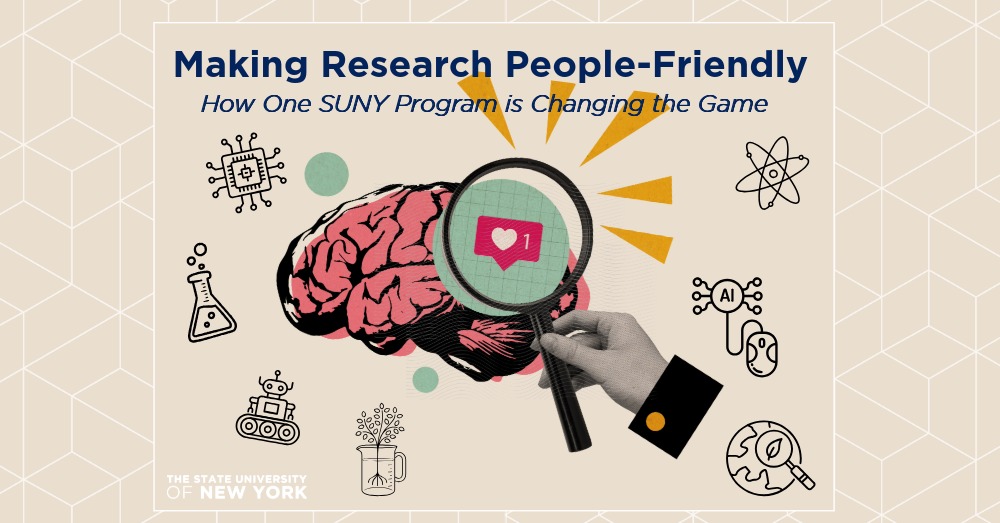
Welcome to the SUNY Research Leadership Academy, a year-long faculty development program that empowers researchers with new communication and leadership skills to make their work more accessible and understandable to everyday people.
The program just finished its first year and is changing the research game.

A New Approach to Supporting SUNY Researchers
The Research Leadership Academy “aims to strengthen the SUNY research ecosystem by building a network of researchers who can work across boundaries, communicate the value of their work, and lead in ways that advance both knowledge and the public good,” according to founder Laura Lindenfeld.
The Alan Alda Center for Communicating Science at the State University of New York at Stony Brook runs the Academy, in partnership with SUNY System Administration and with support from the Henry Luce Foundation. The Academy brings together a group of research professionals for a year-long series of workshops.
 Lindenfeld, Executive Director of the Alda Center, came up with the idea for the Research Leadership Academy after seeing the need to broaden the concept of “research leadership.” The mission and principles behind the Academy supported Chancellor John B. King Jr.’s Pillars of Excellence, SUNY’s drive to double research innovation across the system, and aligned with the SUNY STRIVE Initiatives developed by Senior Vice Chancellor for Research Shadi Sandvik to increase SUNY-wide research collaborations and support ground-up strategic planning across priority research areas.
“At a time when lifesaving and world-changing research is at risk, and the general public feels a disconnect with how academic research provides real-world benefits, an initiative like SUNY’s Research Leadership Academy has never been more important,” said SUNY Chancellor King.
“Often, people assume leadership is about the role rather than the act of leading,” Lindenfeld explains. “Instead, the SRLA is designed to help SUNY researchers not only excel in their fields but also lead in ways that make their work more collaborative, inclusive, and impactful within and beyond academia.”

One participant echoed this idea. Associate Professor Spyros Gallis from the State University of New York at Albany reflected, “[SRLA] reinforced my belief that we need fewer designated leaders and more empowered individuals who lead through action and collaboration. Professionally, it strengthened my connection to a broader academic community committed to innovation.”
Lindenfeld pointed out that SRLA is unique among leadership programs because it is grounded in communication. She said that this is especially important for people in STEMM fields:
“Empathic communication is critical for STEMM leadership if we want to build stronger bridges with society. True leaders enable others to thrive… Great research today doesn’t happen in isolation.”

After working closely with this group, Assistant Professor of Practice and Alda Certified Instructor Radha Ganesan agreed, “Researchers aren’t lone warriors, they’re humans, and they need community as anyone else does. That hunger for connection was already there. The Academy [SRLA] just met it. I’m grateful the Academy gave them a platform to come together and feel it.”
Today, research needs to cross disciplines, involve different campuses and experts, and work with communities, funders, and policymakers. “That requires competencies that researchers are rarely trained in, such as communicating clearly with different audiences, building trust across differences, leading teams, and navigating complex systems to move ideas forward in partnership with different types of institutions,” said Lindenfeld.
Feeling the Impact of SUNY’s Vast Research Network

Because the program included participants from across SUNY, many of the participants met colleagues from other campuses for the first time. Sam Abramovich, Associate Dean and Associate Professor at the State University of New York University at Buffalo said:
“One of the most valuable aspects of the experience was the opportunity to engage with colleagues from very different disciplines, which pushed me to think about my work in new ways.”
This matters especially for Abramovich, whose research and expertise focus on answering the looming questions about how we can advance AI for the public good. In education, Abramovich is redesigning assessment systems so that using AI is expected, transparent, and part of learning, instead of something teachers try to catch or stop. “The goal is to ensure that what we measure still reflects meaningful learning in a world where artificial intelligence is part of everyday thinking and work.”
Empire Innovation Professor Nancy Guo from the State University of New York at Binghamton expressed a similar perspective. She said, “It’s been a privilege to build new SUNY-wide research partnerships while forming genuine friendships along the way.”
Dr. Guo also works in the AI space. With her bioinformatics research, Guo uses AI and big data analytics to improve cancer care. “We develop AI technologies to help doctors diagnose cancer earlier, select the most effective treatments for each patient, and identify new drug options, ultimately improving outcomes and advancing precision medicine.”

These experiences show that as SUNY continues to move forward with its STRIVE approach—bringing people together across campuses and disciplines in a strategic way—research opportunities grow and everyone benefits.
Connecting with Personal Stories

Whether it’s deep curiosity, life challenges, or a memorable experience, these moments have shaped who these scientists are. Sharing personal stories can help others connect with their research.
Reflecting on her experience, Jingyun Wang, Associate Professor at SUNY College of Optometry, said the program “emphasized storytelling, perspective, and leadership in ways that reshaped how I think about impact. It leads to real connection and collaboration.” She believes it’s important to clearly explain why research matters. Wang said, “It is fulfilling when your findings are helpful for patients and their families.” As a pediatric eye disease expert, Wang’s research aims to find earlier and more accurate ways to diagnose, treat, and prevent vision problems like lazy eye, nearsightedness, and eye turn.
“Having suffered from vision problems myself when I was young, the long-term goal is to translate this knowledge into strategies that improve child eye care and quality of life.”

Through undergraduate research, wireless communications network expert and Associate Professor at the State University of New York at Albany, Dola Saha, learned how cellular networks worked. The experience left a lasting impression and changed the course of Saha’s life, leading her to where she is today. Her work focuses on improving the essential connections between our cell phones, weather radar, and GPS systems we depend on. She commented that “Professionally, [SRLA] was a very enriching experience. We do think about changing our language and tone for each audience, but this program has done a phenomenal job in formalizing the process and provided us with tools to connect differently with audiences.”
For Sara Hamideh, an urban and regional scientist and Associate Professor at the State University of New York at Stony Brook, interviewing hundreds of families from various socioeconomic backgrounds who have just experienced a natural disaster fuels her passion to help and advance her post-disaster housing recovery research. “You look at disaster funding, recovery funding, and policy in this nation, and we spend a lot of money reactively on post-disaster recovery. The billion-dollar funding programs are, in effect, a second disaster. And you keep asking yourself, but why? It doesn’t have to be like this.” And there are numerous researchers and scientists like Hamideh who know their research can affect change at the policy level; it is vital that they hone the skills they need not only to their research clearly and confidentially communicate, but also to be unquestionably persuasive. “It energizes me in a powerful way. If we gather more data and knowledge, we could inform the policy to do better,” says Hamideh.

Radha Ganesan knows that shifting to focus on human connection and storytelling can be challenging for these scholars.
“It goes against the grain of how they’ve been trained. They’ve spent years learning to lead with the data and the credentials. We’re asking them to start with the human, and to trust that the science will land better that way.”
Science also isn’t often recognized for its creativity.
Why Science Depends on Creativity
Spyros Gallis is a quantum photonic researcher, which means he studies how to create and control light particles. As an Associate Professor at the University at Albany, his curiosity and creativity are his driving forces. When he studied physics, he was fascinated by how light interacted with matter. He saw that by carefully designing materials, he could control these interactions to unlock new technological possibilities. “Curiosity and transforming complex physical concepts into something useful sparked my passion for this field,” Gallis said
His research aims to develop new hardware that enables quantum technology devices to operate more practically and efficiently in everyday conditions. This is important because current quantum systems operate only under extreme conditions, such as temperatures near absolute zero.
But what does this really mean? It means unlocking the true power of quantum science. Because quantum devices can sense very small changes in the environment, such as tiny variations in temperature, light, or magnetic fields, they are more secure for sending information and much faster than traditional devices.

Michael Mak, Empire Innovation Associate Professor at the State University of New York at Stony Brook, explored a creative solution inspired by his deep curiosity about complex living systems that sustain life to tackle the gap between organ donors and declining donation numbers. The space between life sciences and physical sciences is where physical and engineering principles can be applied to construct complex biological systems, so Mak has developed 3D-printed organs and tissues using these principles.
“I have always been fascinated by the complexities of living systems. To build highly functional tissues and organ models that can eventually be used for regenerative medicine, including tissue repair and transplantation. Ultimately, we seek to develop technologies that can help improve healthcare and patient outcomes,” Mak says. So, yes, you really can 3D-print living tissue, and Mak’s research to help solve the organ transplant crisis our country is still facing is ongoing.
The SUNY Research Leadership Academy has provided insightful and effective training experience. Using the Alda Method®, recently featured in the Wall Street Journal article “Alan Alda’s Solution to Eroding Trust in Science: More Improv,” by Peter Loftus, will enable these researchers to take their communication to the next level, making science more accessible, efficient, and equitable, with broader societal impact.
Core Principles of the Academy
The core principles of SRLA are to address biases, promote inclusion, and encourage collaboration. As co-chair of the N2Women Group, a community supporting women and underrepresented people in networking and communications, Dola Saha works to reduce biases in her lab at UAlbany. Of her six PhD students from five countries, five are women, which is unusual in engineering. Saha says:
“It’s important to know and acknowledge that we all have unconscious biases. That gives us more power to actively think of mitigating any bias we may unknowingly have.”
Another hot topic: the biased results that AI tools have produced since their public explosion into the zeitgeist.
When AI systems use data that lacks diversity or contains inequalities, this only reinforces stereotypes and discrimination. Sam Abramovich explains:
“I think about inclusion in terms of who our systems work for and who they exclude, particularly in assessment. As AI becomes more embedded in learning, there are real risks around unequal access, bias in tools, and assumptions about how students should demonstrate knowledge.”
He adds, “Incorporating this mindset into my work means designing assessments and policies that are transparent, flexible, and attentive to those differences, while also fostering collaboration across disciplines and roles.”
Sharpening Communication Skills Starts with Listening

The scale and diversity of SUNY, along with its commitment to public impact, means that researchers can benefit greatly from the communication and leadership lessons taught by SRLA. Radha Ganesan reminds the participants:
“When you strip it down, [it’s] people paying attention to each other.”
This sentiment captures the Alda Method, and the program’s collaborative nature was a highlight for many participants.
“Communication is a skill that gets sharper every time you use it.”
She reflects that she can see the moment it clicks, and though it is the simplest thing, it is the hardest thing to do:
“…connect with your audience first. It must come before everything else—the slides, the data, the terminology—ask yourself first, what do they actually need to hear.”

“This program proved to be unique. I hadn’t encountered this specific type of training before, and it was a surprising and welcome shift in perspective,” said Nancy Guo. As the pilot program year closes out and plans for a second year begin, Guo hits the bullseye. SRLA stands out, just like the research projects the participants are working on do. Its impact is seen in the trust built, the partnerships formed, and the ongoing growth that will continue as science and research become more accessible to a broader audience.
————————————————
Want to learn more about these SUNY researchers? You can find them on SUNY Research Connect.
To learn more about the SUNY Research Leadership Academy, visit: www.stonybrook.edu/suny-research-leadership-academy